
So, I have used several math programs over the years, but the one I have consistently used the most, has been Math U See. Today, I’m going to review the program and let you know what I do and don’t like about it. This way, you can decide if it is a good choice for your child.
Alpha, Beta, Delta
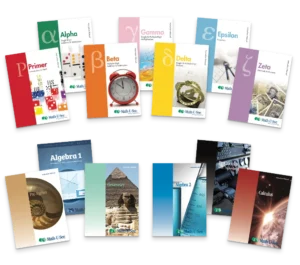
I need to be up front, I did not use the earliest 4 or so books of Math U See. We used various other programs, including me just using a white board and an abacus to work on the basics of addition, subtraction, multiplication and division, as well as various other early math topics like money and time telling. I played games, used various worksheets, and did math in a way that just met my kids where they were. So, those levels are not covered in this review.
Epsilon
We started using Math U See at the Epsilon level. I will say, I do respect a program that doesn’t tie their program levels to grade levels. In my house, two of my kids were ready to start doing fractions the same year, so rather than worry about grade levels, we just did that. This means we tested this program with a whole lot of different kinds of neurodiversity. Interestingly, neither of my kids has ever wanted to use the videos for MUS. We have watched samples, and they have asked me to just teach it myself from the teacher’s guide. For me, this has been possible, but not without challenges. The MUS manipulatives are mostly self explanatory, but I have had to work with them to be able to use them for some lessons. Most lessons the teacher’s guide has quality instructions, but every so often, we go to do a worksheet and feel the directions in the video must have included something we did not have.
In general, my dyslexic kid really prefers the simple pages with minimal text that dominates the MUS style. The problems are spread out and there is room to work (most of them) on the same worksheet. The program also has a minimal number of word problems compared to some other programs. This has also been helpful for this child.
My AuDHD child also prefers the simple pages, but even more, benefits from the methodical build up on concepts we have seen in the program. This means that each lesson feels doable. The material moves at a slow and steady pace, which I have not found in some other programs. This method means that my child who fears failure, doesn’t fail very much. I did not choose to make a big deal of missed questions for them either. Instead, we just did more worksheets, and before doing another one, I retaught topics that were apparently not well understood.
Zeta and Pre-Algebra
Despite what the book recommends, I let my kids use calculators with these levels. They literally can take a calculator everywhere they go, and long division and such never really stuck for them. I  found both of these levels to be good foundational math skill levels. However, we did not need as many worksheets as the programs come with, so I shared one workbook between the two kids. In general, one kid did worksheets A and D and the other did B and either C or E. As page D usually introduced a topic for “review” that may or may not be review at my house, I was careful about who got which worksheet as far as knowing which kid needed what review to do.
For my kids, these levels were completed in late middle school or early high school. Yes, I know that not everyone would be comfortable calling Zeta high school level math, but it was the math that child was ready to do in high school, so I called it 9th grade level math on a transcript and moved on. It was solid math instruction.
I will also say that I found the Pre-Algebra level to be rather comprehensive for preparing my kids to start this Algebra program. I also liked the manipulatives as they really helped one of my kids get the most of this program. I used them with each child, but not all of the kids needed the visual assistance to understand the concepts the same.
Algebra 1
This book is one of the very few that actually was used by all 3 of my kids while homeschooling. While it is not the only Algebra program we have tried, it has been my favorite. It feels methodical and straight forward. It takes the student through a wide range of topics, though there is a lot of graphing, and covers the typical things. It is light on word problems compared to other programs, but they may have solved for that in the newer version, which I have not used. I chose to use the “Legacy” version with my youngest though the new version had just come out, because I wanted to stick with the familiar format I was comfortable with and that was working here. I’m not a fan of changing programs just to change programs.

I honestly do not know if this Algebra program is robust enough for a student who wants to be a math major. I am not raising those. I am raising kids who need a basic understanding of Algebra to pass some basic college courses. For our purposes, this program has been good. If you know you are raising a physicist or an engineer, you may want something else.
The topics covered in this Algebra 1 program are honestly the handful of things I remember from high school Algebra 1. I may be misguided but that has led me to believe it is a reasonable list of topics to cover. It has also made it easier to teach than a “new math” version that would ask me to learn several alternative ways to teach the material.
Geometry
I recently started using the Math U See Geometry program with my youngest. It continues the same style we have gotten used to and we have been able to move fairly quickly through the first several lessons. In my heart, I am pretty sure there are topics that my high school class covered that I do not see in the table of contents. That said the basic concepts of geometry are all present. The program presents angles, lines, graphing and solving proofs in an accessible way that has lowered my stress about teaching math.
I feel really good about sticking with this program for the rest of our high school math needs. As an adult, there are a whole lot of math topics I learned in school I have never needed. So, I am okay if these programs skip a few things. What they do cover, seem to be the most important topics usually covered in these courses. They cover them in a way that works for my child’s brain, and that is what we need most.





0 Comments