
I am a big believer in learning literature, and I’m happy to share my ideas with you. This semester, I have been co-teaching a class on Shakespeare at our local co-op. It has been fun, engaging, interesting, and a bit harder than I expected. While I had taught Shakespeare to my own kids, I had never taught it in a group before.
Most lesson plans wanted me to spend 5 days a week for 6 weeks studying just Macbeth. That pace might cover a ton of topics and backgrounds, but I like for my co-op classes to move faster than that. I looked at tons of free lessons on line, and ultimately had to make up a whole lot as I went.
I am going to share some of my favorite activities we have done this semester, in case you are looking for ideas about how to teach Shakespeare in your homeschool or co-op. My goal, is to bring the material alive in multiple ways and help modern students relate better to something they often think is just too old to be interesting.
 Why teach Shakespeare?
 Why teach Shakespeare?
This is something I discussed with the class the first week. What do we study Shakespeare? We study him and his plays because he managed to write stories that are so good, they are still entertaining today. His stories have been reworked to be retold in other times and places. They have universal themes of asking what a person does when faced with a hard choice? Do you kill a king to become king? Run away with the girl? Just run away?
Despite the fact the stories are 400 years old, Shakespeare’s plays have a lot of things we still find interesting. Many of his popular quotes turn up everywhere from cartoons to books to movies. “Boil, boil, toil and trouble,” always invokes the image of 3 witches at a caldron, and that is the magic of Shakespeare!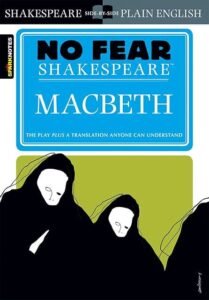
Getting Started
If you plan to teach anything about Shakespeare, I recommend taking some time to learn about his life, his time period and the Globe Theater. Remembering that all the original actors were men, young and old, can make it more obvious that some lines were jokes with the audience. When Macbeth says the witches have beards, this is a joke with the audience about having men play all the parts. Many of his comments and jokes are focused on his own time period, and learning more about that can help your student get more from your lessons.
Macbeth
Why did we choose to study Macbeth? Honestly? My kid thought it sounded cool and that Romeo and Juliet sound like they “don’t have any sense.” But I’m happy with the decision. I had forgotten all the many themes of Macbeth that a modern audience could relate to. I’m going to break down some of the activities we did by act so you can use them if you want to.
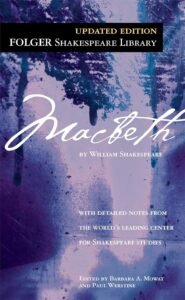
No Fear Shakespeare has some excellent scripts for plays that have the original words on one side of the page and a modern version on the next page. This can make translating the play into plain English a lot easier for your student. I also got a copy of the Folger Theater script for Macbeth, which includes explanations of various words and phrases that also makes the original text easier to understand. Having more than one copy was helpful for making sure I understood what I was teaching.
I also want to recommend the Folger Teacher Guides. The guide I purchased had a ton of ideas, far too many for our time, but reading the book gave me SO much insight that I was able to bring to my class. A few of the activities we did were adapted from that guide, though they needed adjustments for the smaller class, as the Folger Teacher Guide assumes you have a typical public school class.
Act 1
I think it is important to not just jump into this play, but to set the stage. Why did Shakespeare write the Scottish play? James the first of England had just become king. Before taking over the throne from his cousin, Elizabeth the first, he was king of Scotland. Merging the two countries under one crown was a big deal. But Shakespeare was probably most worried about his own life. He needed to retain the good will of the crown both to be sure he kept his own head, and to be sure money flowed to his theater so he could keep working.
Before jumping into Act 1, we took the time to go over the plot line of the whole play. Learning Shakespeare is not about learning the basics of the story, it is about the language, the characters and the emotions. This means that it is a great idea to watch or read an overview of the play before you start.
Act 1 then introduces most of our main characters. I will be honest, due to time, I did skip a fair bit of act one where they are talking about how well the battles went. I don’t feel this part relates well to a modern audience and those scenes can be summarized without missing important parts of the story.
Act 2
This is where we meet Lady Macbeth and she makes some lovely speeches about how she wishes she was a man. While she plans the murder of Duncan, she doesn’t have the power of a man in her time period. For the sake of keeping things interesting, I had the class listen to “The Man” by Taylor Swift. I then put them in pairs and had them create a mash up of Taylor’s lines about “if I was the man, then I’d be the man” with Lady Macbeth’s lines. 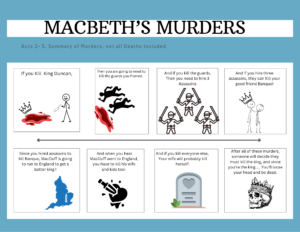
Personally, I love this poetry mash up and it drove home some interesting points about how women have been treated through out history and in the modern era. What does it say about us that both Lady Macbeth and Taylor Swift wish to be the man? This also sets your student up to look for all the rest of the places in the play where a character is told to “be a man.” Usually, this phrase means “go murder someone” which leads into a further discussion of whether masculinity is to be associated only with violence? And if so, what is that? Is that also something we can find examples of today?
Act 2 also includes the first ever knock knock joke, which is told by the Porter. It is actually a pretty bad joke that doesn’t land very well with modern audiences. It is an honest debate to have as a teacher of whether you will teach that part or just skip over it. I found trying to substitute jokes about modern people helped, but was tricky.
Act 3
Act 3 is when the murders start to pick up speed. There are SO many murders in this play that they start to become comical. For this reason, I created a mash up of If you Give a Mouse a Cookie with Macbeth. I felt my students needed an easy guide to what was happening. It is just SO many murders. You may find some other form of chart or graph helps your student keep up with who is dying where, but know that it is okay to make it light. Shakespeare’s audiences were used to death in a way that we (hopefully) are not. But it is important to note that this part of the play is supposed to be over the top.
The goal here, that you can use with any other literature, is understanding that you can actually compare ANY two pieces of literature if you look hard enough. Students who struggle with literature summaries and comparisons often do really well when asked to look at picture books. Picture books are often excellent options for easy literature with deeper meanings when you want to help your students learn to do comparisons or learn about style.
Act 4
This is when Macbeth returns to the Witches and they have a wonderful long scene making their brew. For this scene, I had my students make our ingredients out of play dough so we could throw them in the cauldron while acting out this scene. I made index cards with the words of Shakespeare on them, and then added in parentheses the name of what it actually was, if it wasn’t obvious. In this case, I had to both explain some words of the time, but also explain that modern scholars say that the names of many of these spooky ingredients were likely herbs. For example, eye of newt was mustard seed. We had a good class discussion about the ingredients as well as discussing how lovely the rhyme of this section of the play is.
When it came time to act out our scene, I had witches’ hats to wear and a big black flower pot to throw our ingredients into. The scene came alive and was a lot more fun to act out this way!
Act 5
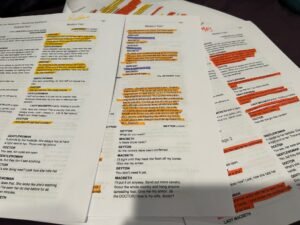
This final scene involves a big battle- time to pull out some foam swards and have a little fun! For this act, I printed out a copy of the text for each of my students and assigned them a color and highlighted their lines in a single color for their script. This means I can assign ahead of time a single student to read anywhere from 2-7 characters. There are a lot of small parts of servants, so many of those parts are very short. So working ahead of time, I can try to balance the number of lines my students will do by assigning their parts in each scene. The play has worked out very well for having 4-6 people to read parts. It turns out, there are not a lot of times that more than 4 characters are doing lines together.
On the topic if highlighting parts- I highly recommend you ask your students what colors they like for high lighting their parts. Some students actually do a better job reading when their part is in blue or yellow. It has to do with how their eyes handle color and light. Not all students will care, but on the off chance they know they do a better job reading in pink, you might as well accommodate them.
How I made this a lesson plan
In addition to the above activities, we read the play together, one act at a time. A few times we had to skip a scene because we ran out of time. However, i summarized any skipped scenes. As you read the play, you should be able to decide which ones just lack action or are not driving the play and our main characters.
My other favorite method of teaching high school students, is being able to assign to them some videos to watch outside of class. This means they get perspectives other than our small group can bring to the table, and allows them to think more on what we are exploring. There are TONS of videos you can use as part of your homework on Macbeth. Here are a few of my favorites:
Crash Course Macbeth Part 1 and Part 2
I hope some of these ideas make Shakespeare feel more approachable for you and your student!




0 Comments