
The FDA just came out with a new food pyramid, except they inverted it. As in, it isn’t really a pyramid anymore because it is just an upside down triangle. But hey, if it helps us all eat healthier, it is a good thing, right? I’m going to give it an honest critique today, as far as how you can and can’t use it to teach healthy eating with your child.
The New “Pyramid” 
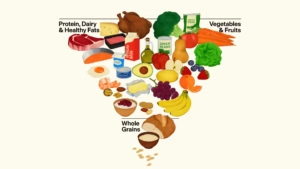
The new food pyramid says to focus your meals on eating more meat and vegetables. Those are at the top of the pyramid and easy to see. At the very bottom is a loaf of bread and it’s friend, oatmeal (I think). The middle is where I worry the artists got confused. Eggs, shrimp, butter, nuts and various fruit all hang out together in the middle with no real distinction of category or serving quantity. If I am reading the chart right, I should eat more nuts than grains today. Is that right?
Well, if you dive into the reading material that goes with the new chart, nuts are now categorized as a protein, not a fat, so yes, I am supposed to eat more of them than I do whole grains. However, that doesn’t explain their placement on the picture. There is also nothing to explain why a block of cheese is higher on the chart than the piece of salmon. From what I understand, the vast majority of nutritionists would advise we eat more salmon than cheese, if it comes down to an either-or choice.
The new eating guidelines for Americans emphasizes eating whole foods and avoiding processed foods that contain more sugar and salt. The new pyramid appears to just be backing that idea up with pictures of whole foods. Ultra-processed foods are completely absent. The problem is, ultra processed foods were never on any version of the food pyramid though I think many sugary cereals and such tried hard to pretend they were on there.
Pros and Cons, as a Teaching Tool
If you are working with very small children, using the new food pyramid to identify pictures of healthy foods can definitely work. You can even use a picture book like The Very Hungry Caterpillar to compare what the caterpillar eats to what is on the food pyramid. You can point out a few of his choices, are not on there and talk about why. 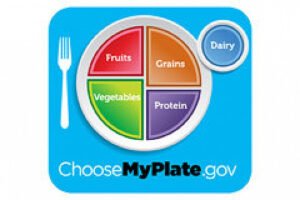
However, if you are talking to middle or high school students, this pyramid alone doesn’t have the information they need. They need more in-depth information about how many servings of what they should eat each day. They need to know how big a serving is. The links I gave above have that information, but it is not in an easily digestible format, like the My Plate program was. My plate was an easy-to-see image of how we should eat all the food groups at each meal. It didn’t include processed foods either, despite the fact it looks like it is also on the way out.
What Is a Parent To Do?
Personally, I will be continuing to teach the basic food groups of: vegetables, fruit, grains, dairy and protein. We will talk about fats, processed foods, probiotic foods, like yogurt and pickles, as well as how a diet is supposed to be diverse. When my own kids tell me they feel hungry despite having eaten already, I ask “what food groups have you eaten?” Then we look for a snack that has nutrients they may have missed. I don’t really see a place in our home for the new food pyramid. It doesn’t present the information in a way that works better for us.
I do miss the clear information on the old food pyramid. It had problems, but it did clearly label the food groups and state how many servings of each food you should eat. I wish the new guidelines were that clear.
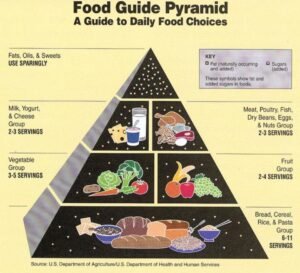
The old food pyramid with clearly defined food groups and number of recommended servings.
Problems With It
That is my real complaint here. I just don’t think this new pyramid makes it easier to teach my kids how to eat healthy. On that topic, nutritionists are divided on some of the new guidelines. While everyone agrees whole foods are best, they don’t all agree on the recommended quantities. Dietitians and nutritionists are pointing out that the new guidelines may not be appropriate guidelines for those with kidney disease, who need to eat less protein, for example. Personally, I need a little more carbohydrate to get me through the day than the 2-4 recommended servings, otherwise I am going to be fast asleep all afternoon.
For those of you that have our American History program, there is a good health lesson in the unit titled “Expanding the Colonies” that has a diagram of foods as a circle. It gives another perspective on teaching why eating a verity of foods is important.





0 Comments