
Lately, my mantra is “something is better than nothing.” This applies to homeschooling, house cleaning, and most of my life. Let’s dig into what I mean, and why I am leaning into this.
 First off, I want to be clear, If you are “normal” and full of energy and your kids do whatever you want to do from sun-up to bedtime, today’s post is not for you. This one is for those of us with chronic health issues, learning disabilities, and other obstacles to normal daily life.
I Just Can’t
For several years, I have been struggling with health issues. This means I often don’t have the physical or mental energy to do what I used to be able to do.
I also have a household full of neurospicy people who don’t always have the dopamine to get things done. This applies not only to myself but to my kids. Even the dog seems to have days he won’t participate. It is just how our household works.
Something vs. Nothing
 Now, there is a tendency in our society to say “if you can’t do something right, don’t do it all.” This is toxic. That isn’t reasonable. The truth is, if you have enough physical energy to do 5 minutes of effort, it is still better to put in your 5 minutes of effort, than to not try. Let’s look at some physical examples.
I only have 5 minutes of effort to give, I can’t clean any room in 5 minutes. However, I can use that 5 minutes to do one small task. I can clean a toilet. I can wipe down a sink. I can start a load of clothes washing. The bathroom isn’t clean and the laundry isn’t done, but I did something, and our life is a tiny bit cleaner for it.
The best part of this plan, is that I can tell other people I live with that I started a cleaning task and ask them to finish it. I can have a teenager put those clothes in the dryer. I have even had days where I had one minute of effort, so I put the soap in the toilet to start to clean it. Then I asked a kid to give it 5 minutes to soak and then go finish cleaning it. For some reason, their neurospicy brains like that the task feels shared, even if all I did was squirt in the soap.
Homeschooling in Small Bites
If your child has a learning disability, school work is harder for them than a typical kid. There are a million ways it can be harder. It can be harder to start, harder stay on task, harder to read, harder to differentiate between background information and what they need. That isn’t an endless list either, just a few examples.
I have found that focusing on what we can do in 5-15 minutes has been the key to getting more education in less time. In general, it is 5 minutes with elementary age, 10 for middle school and 15 for high school.
Now, what can we do with high value for that many minutes?
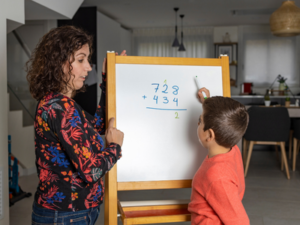 Your elementary age student can watch a 3-5 minute video on history, science or other topics. They can spend 5 minutes putting together a map puzzle to work on geography. They can do 3 math problems on a white board. They can copy one sentence with good handwriting to work on letter formation and attempt to learn spelling that way (it works for some kids but not all.) They can read out loud one paragraph.
Now if you did all of that, your student (doing each activity for 5 minutes each) has completed 5 different areas of education in less than 30 minutes. They have had lots of short quick wins, and can now go play with those concepts.
As your kids get older, you can basically use this same method and keep in mind the short lesson format. Find videos that are 10 minutes long in middle school and 15 in high school. If a great video is shorter than that, don’t skip it! Consider watching a second video on a related topic.
How many math problems can they do in the assigned time? Doing a few short problems every day often helps students gain skills better than long assignments where they mentally check out midway through the lesson. Consider teaching a topic one day and then doing the reinforcement problems the next day.
 Look for grammar, writing, and reading assignments that are short if this is an area your student struggles. Longer lessons are often just longer, not better. Teaching a high impact idea, like when to use a semi-colon, and then applying it quickly for 10 minutes is going to stick better than reviewing every possible punctuation option for an hour.
But does it work?
I have two kids in college who I taught this way. We did do longer assignments, but only when they were engaged and ready to work longer. A lot of the time, I needed to keep lessons short. Their ADHD brains were not going to do long boring lessons no matter what I wanted or the program called for. Anything you can do in 2 hours of sitting at once, you can do in 15 minute chunks and probably with better results. Because those 15 minute chunks were times the child’s brain was ready to engage.
Yes, something is better than nothing. An education done in tiny bites is far better than just giving up. Hang in there. Normal is overrated.




0 Comments