
When a person has autism and ADHD that is now called AuDHD by a lot of the people I talk to. I’m not sure how common that phrase is right now, but it is getting there. Today I want to talk a bit about the challenges of homeschooling your AuDHD child, and what it can look like beyond high school.
Maturity
 First, it is important to understand that the executive function and ability to stay on task of a child with autism (ASD) or ADHD is generally going to be about 3 years behind their peers. This means your six-year-old can’t do anything alone, the same as a 3-year-old. Your 12-year-old is going to struggle with house hold chores the way a 9-year-old would. And your 18-year-old has the organizational skills of a 15-year-old, at best. So you don’t lose your mind, your first step is to recognize your child is going to need you more than a typical child needs a parent for homeschooling and beyond.
This maturity gap can also extend to emotional maturity and social maturity. The AuDHD child may be slower to understand someone else’s point of view or feelings, as compared to their peers. They may be more emotionally unstable. I don’t mean that in a scary way. I mean your child may be more likely to become upset about mistakes, misunderstandings, or miscommunications. These things happen with all people, especially young people, but the AuDHD child or teen usually will have more struggles.
Teaching Executive Function
Before we jump into this, one thing to understand is you can only teach what the brain is ready to learn. This applies to reading, math, and organization. Executive function is your ability to plan, prepare, and get things done. It has to do with the brain’s ability to organize information, form a plan, and act on it. Follow through is part of the challenge.
Okay, so I just took a moment to see if I have written much on this before, and six posts came up with “executive function” in the title. Why am I writing about this so much? Because in my experience, it is the number one struggle of homeschooling neurodivergent teens. And the thing is, if your child is ND, you might very well also be, and struggle with executive function yourself. So, how do you teach a skill you yourself struggle with? It isn’t easy.
So, you should go read those, because I can’t put it all here today. But you are probably going to spend your child’s high school years cheering them on with constant help to get things done. They need rewards, encouragement, and help planning. Unfortunately, that doesn’t end at graduation.
Starting College
 Some kids are ready to go off to college at 18. Your AuDHD kid is less likely to be ready to do this. But why? I don’t mean academically, though they may need an extra year or two of school if academics has been a challenge. They may also have basic life skills, because you made part of your curriculum teaching them to cook and do laundry and care for themselves. But are they ready to do all of that at once on their own?
It isn’t a failure if your child, whose brain needs more time to get to the same level of frontal-lobe development, isn’t ready at the same pace as the neurotypical kids, to do college. Our family has decided, together, that our AuDHD kid would start at the community college. Our state has an excellent transfer program, and the community college is near our home. It costs less than half for the same credits, too. AND, best of all, my kid can be enrolled for exactly the number of credits we all agree should be on their plate without penalties. Our local 4 year college has some complex billing that makes students be part time or full time and pay based on that. Our community college has a set price for each credit hour, with no penalties for taking more or less.
Using the community college means my student can stay at home and have help with the executive function. What might that look like? Making sure they got up when their alarm went off. Handing them a breakfast they can eat on the way to school. Making them coffee in the morning to get them going or packing their lunch. It can mean asking if they did their homework. At times it has meant proof reading an assignment or reading the assignment out loud to help the student be sure they understand what they are supposed to do. It might also mean helping a student figure out how to approach a complex, multi-step assignment and coaching them to choose what to do first, second and third.
That sounds like a lot doesn’t it? I have NOT done all of those things on a single day. Those are all things I might do, depending on how the kid is doing. Today they might need help waking up, because their body didn’t want to turn off last night. Tomorrow, I might be worried they are forgetting to eat and pack their lunch. This weekend, I will be asking if their homework is going okay.
 As a homeschooler, they didn’t have to do those things before starting college. Even with doing some online classes and in person co-ops, they didn’t have to be responsible for themselves as much as college requires. They didn’t have as many assignments or challenges. Even if we went over those skills, they didn’t get in the habit of doing them every day. So, these years of community college are a time they are building skills other kids might have learned in high school. That’s okay. Easing into adulthood doesn’t mean you aren’t going to get there.
Pulling Back
The tricky part here, is figuring out how often to let your child fail. I don’t believe in leaving kids or young adults to fail at life just because they have reached a certain age. However, I’m not doing their homework for them. I’m not going to be their alarm clock, personal chef and calendar forever and always.
The key to pulling back is helping your student figure out how to do the things they are struggling with. This can take some trial and error. If they struggle to get up, do they need an old fashioned alarm clock? Do they need you to let the dog in their room when you get up so Spot does the job of waking them for a while? Do they need to think about their bedtime routine? Coach them to find their actual problem and solution. Support them in the way they need, even if you aren’t sure they are making the right choice. Even if their first solution doesn’t work, it helps their brain understand a bigger picture of why they need to consider other solutions in the future in other scenarios.
Offer Lots of Organizational Tools
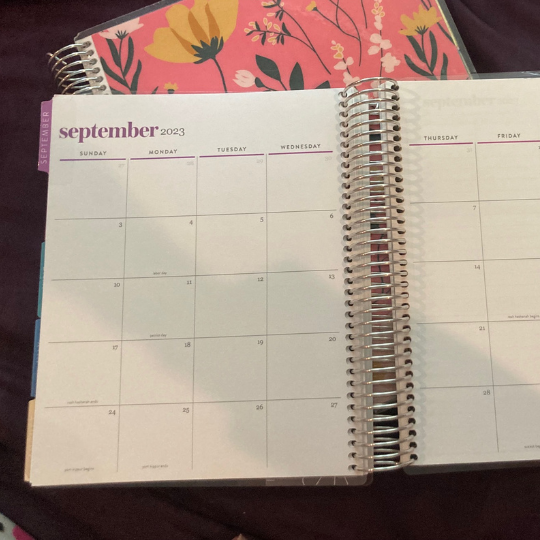
 Organizational tools are really, really hard for the ADHD brain to use, but it is worth a shot. Over the years I have presented my kids with lots of ways to organize themselves and helped them try things out. A paper planner appeals this year to one of my kids because it came with a lot of stickers and colors. The cheap ones of years past never appealed, but this more expensive one is working for this week. Some do best with a Kanban board of tasks written on post it notes. Others prefer a digital experience like Trello. A Google Calendar of due dates might work for some. Your student should also see what digital tools their school provides. However, it is important to note that my experience says those tools can go offline and be unreliable so a back up plan is helpful.
Support the Struggle
It is important to realize your kid will struggle at times. Everyone struggles with the transitions to adulthood in some way. Don’t write off things as failures that are just times your student learned something hard. Maybe they had to drop a class before they got an F. Maybe they had to take a class again because they did fail something. Maybe they discovered they were in the wrong major and they need to try something else. Those can all be super frustrating for a parent, especially if your own parents didn’t allow you to fail without punishments. However, the natural consequence of failing a class is taking it again, not losing use of the car. Personally, I have said I will only pay for any single class twice… after that you gotta find other funding. So far, no one has needed to take something more than twice. Do I love paying for a kid to repeat a class? No. But interestingly, each time that happened, kid had a different teacher and learned different material with the same course title, so it really was a part of their education. Not great for my blood pressure, but great for their education.
Lastly
Be kind to yourself. This phase of moving your child towards adulthood is hard. It is my least favorite thing so far. It is even worse than one-year-olds, and I did not enjoy the constant fear that age invoked as my child refused to understand they could not, in fact, fly. But we are all going to get through this. They will get there. I’m sure of it.




0 Comments