
I am seeing a lot of debates about homeschool oversight and a lot of fear from other homeschoolers about what that might look like. I think the most reassuring thing to do, is to look at states that have oversight requirements and compare them. Find out if homeschoolers there feel the requirements are difficult or easy to meet. I would encourage legislators considering adding requirements in a state that hasn’t had any to look at the laws of states with successful laws. Today, I will be sharing about what we have to do in Virginia, and how that has been as a parent of neurodivergent kids.
The Laws
The short summary of Virginia state law, is that every year I have to send in a letter to tell the county I live in that we will again be homeschooling. This is my notice of intent. I have to “prove” I am fit to homeschool either by providing a copy of my diploma. My high school diploma is sufficient, but they will accept diplomas from colleges as well. I then provide a list of subjects I will be teaching and a list of my students. The law has a couple of options for families without a diploma, but having one does make the paperwork go faster.
Then, at the end of the year, we send in either an evaluation letter about your child written by someone with a teaching license or a Master’s degree, or a set of nationally normed test scores that are high enough for the state to be happy. The minimum test score required is that when you average together the scores on math and language arts, the child scores above the 23rd percentile. Parents get very worried about their child doing well on these tests, but the truth is that they can miss lots of questions and still score high enough for the state’s requirements. The goal is to make sure the child is getting a bare minimum education.
Nationally Normed Tests
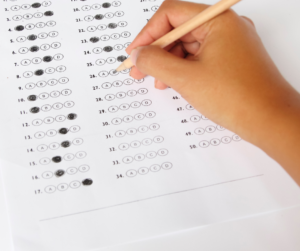
I mentioned that the test has to be “nationally normed.” What does that mean? That means that the test was developed and tested on a LOT of kids before you got a copy. They gave it to a huge number of kids and tweaked it to be able to say “an average American child can score in the 50th percentile on this test.” They also want only a small percentage of children to score up in the 90th percentile range and an equally small percentage of children to score in that low, 10th percentile range. Those children either know far more, or far less than the majority of their peers.
This means that on a nationally normed test, an average child getting an average education should have some questions they can easily answer at their age, a bunch they can answer with some thought, and at least a few that are way too hard for them. Those way too hard questions are to help weed out who is in the 75th percentile from the 95th. For the sake of state testing to keep homeschooling none of those matter. Am I delighted when my kids do well on these tests? Yes, of course. It validates me as an educator that they are doing well compared to other kids. However, the proudest I have ever been was when my dyslexic child put up a “slightly above average” score on reading comprehension. That 60th percentile store was HARD won. Sometimes getting up to average is a very big deal!
One other thing to know about nationally normed tests, is that they have to state the year they were normed. This means they gave that test to all those kids, in a specific school year, and the test scores compare your child not to kids taking the test today but to the scores done in that school year. If it is important to you to compare your kid to kids today, you will want to choose the newest test you can find. The IOWA form E was just normed in 2024 so it is the newest. I have given the Terra Nova, which was normed in 2005 several times and liked the format. However, it is not uncommon to see homeschoolers giving a version of the CAT from 1986. I have used that one and I do not like how dated it is at this point. It asks kids how to look things up in a phone book, for example.
The truth is, you are using any of these tests to prove to the state your child can do a minimal amount of reading and math. And honestly, if they score really high in one area, they can basically bomb the other and the averaged together, composite score, will still be high enough to meet the minimum our state requires. In that case, parents do usually make sure to black out the individual scores and only send in the composite as required by law. Some parents feel it is important to do that in solidarity to protect us from school boards over reaching and asking for individual scores that our state law does not require we hand over.
Evaluations

Evaluations in my state serve a couple of purposes. The obvious one, is that it creates a way for parents of kids with significant learning disabilities to homeschool and meet the legal requirements. If you have a child who is unable to show what they know on a test due to anxiety, an evaluation is an option. if you have a child who is dyslexic and reading several grade levels behind, evaluation is a good option. If your child has significant delays and their growth just can’t be measured with a test, this is a great option. In all those cases, the goal here is that an adult who is not the parent sees your child and their work in some format and says “this child is getting an appropriate education.” It is never ever discussed, but I do believe the goal here is to also prevent abuse. The person writing the evaluation usually charges a fee similar to the cost of a test, for their time, but if they see signs of abuse- they can report it. I have never heard of an evaluator reporting a family, but for those who worry that these disabled kids are not having contact with outside adults, this is a potential safety net.
Evaluations are also good for families who are approaching education in a less traditional fashion. There are many educational models that do not teach reading until age 7 or 8, and for those families an evaluation for grades 1-3 make the most sense. Families who follow an unschooling methodology, may feel an evaluation best shows how their child is learning and growing, rather than a traditional, sit-down test.
Which do I prefer?
Honestly, I prefer using an evaluator during the elementary years, because I do not see any benefits from testing a child who is still learning the basics. That doesn’t mean the tests are too difficult or are bad, I just don’t care for them. However, by high school, I do think it is good for kids to have the practice of taking timed tests. It is good for them to see if they tend to need more time than other students. it is good for them to practice guessing on questions they are unsure about. Those are not things that are typical of my curriculum choices. It also lets us see if we should pursue testing accommodations in college. Doing a standardized test in high school is very low stakes and a good way to learn to take tests.
The Loop Hole
In Virginia, there is a loophole option that lets your avoid real oversight. You can do the forms to have a Religious Exemption from formal education. This option is written to be for those for whom it is against their religion to participate in the government. Think sovereign citizens who don’t have birth certificates or social security numbers. However, the option is used by a wide variety of people with a variety of beliefs. Those who use this option, do not have to file any of the annual paperwork, nor do they test or do evaluations. Last year, a move was made towards removing this option, but it did not make it out of committee, as the bill was very poorly written and did not align with our other current laws.
I have not used the RE option and can’t really defend it, as I don’t understand it. I’m unclear on how it can be against your religion to have a social security card or an education. But, if a state is moving towards regulation, it is worth noting that our state created this loophole, and yours might too.
In a way, this means that those of us who are willing to have oversight, have it. The people who refused to have it, have a way to homeschool without the guardrails that most people agree are there not to cause parents issues, but to prevent educational abuse. I would not be surprised if our state legislature, which is all democrats this term, won’t take a stab at changing the laws around the RE again soon. Instead of removing it, making these families meet annually with a social worker to prevent abuse could be a proposed compromise. However, funding for those social workers would need to come from somewhere, so that may not be doable.
Does This Work?
I actually think the Virginia method of oversight makes sense (excluding the REs). If a family turns in low scores on nationally normed tests, below the 23rd percentile, the first year they have to make a remediation plan. If it happens again, they are asked to send their children to school to make sure they are getting an education. That said, you can avoid that entire situation, if your child just tests poorly, by using an evaluator who can coach you on how to help your child learn best.
I have a child who did really poorly on a few test sections the first year we lived in Virginia. I realized that there were a few gaps we needed to fill. My child had no clue how to use a comma. She was in the 4th grade and our curriculum expected her to pick them up through osmosis. Apparently, that didn’t work. However, a grammar workbook and a few weeks of practice before the next year’s test brought the score from failing to above average. I also have found that teaching some basic test taking skills and explaining how to do a multiple choice test has really helped my kids do better on those tests. As college requires a lot of multiple choice tests, that has not been time I consider wasted.
I don’t think this method guarantees every child an ideal education, but that isn’t the mission of public school either. What it does is gives us some guard rails to make sure kids are not falling through the cracks. It makes sure parents are either checking in with another adult or with a test, to be sure their kid is on track. And it does this with minimum work added to an already stressed public school system. The school doesn’t have to give the test, or do the evaluations. We send in the paperwork each summer when school is out, for the most part. So, school systems check off they have a letter in the fall declaring I will be homeschooling my kids and then next summer, they can check the box they got the evaluation letter or the test scores.
Overall, I think this system not only works for homeschoolers, but puts minimal stress on an already overworked school system. It checks the boxes of oversight without putting an undue hardship on anyone. I am aware that other states have found a different way to have homeschooler oversight. Please feel free to share in the comments what your state requires and if you think it works well.




0 Comments