
One of my goals as an educator, is to make math lessons feel less separate from everything else. For some reason, we can come up with ways to teach literature, science and social studies together, but our educational tools don’t play with math very much. Math is treated as a separate skill, and if you aren’t good at numbers, you aren’t good at math. But the trouble is, math is SO much more. Math is communication, patterns, and even art.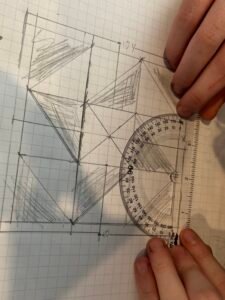
So, in a quest to combine math and art right now, my homeschool is doing a lesson on geometry and quilting. Now, the first part of this lesson requires no sewing, and is actually great for your child’s visual perceptual skills. So if all the art you want to make involves colored pencils, stick with me for a bit, this is still a lesson you can do.
The Lesson
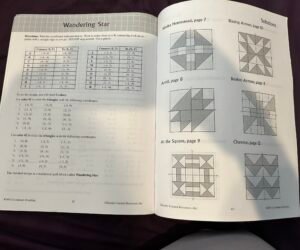
While there are various online lessons about quilting, I chose to start with the book Coordinate Graphing: Creating Geometry Quilts by Teacher Created Resources. The book has a page to copy that is basically graph paper, and instructions for students to use sets of coordinates to draw the lines and shapes that make a quilt block. The back of the book has pictures so students can check their work. We of course, threw out the directions.
I let me student choose a picture of a quilt block in the back of the book and the flip to the front to follow the directions to draw it. While the book has instructions for coloring in the block, I let my kid color the shapes in any pattern they chose. The first block was a learning experience. However, left alone with the book, colored pencils and plenty of graph paper, my kid created a variety of quilt block designs. While the lines and shapes started out based on the blocks in the book, the new ones had color themes and styles that made them uniquely hers.
The Skills
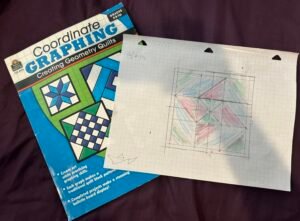
First of all, being able to graph lines correctly in a positive and negative plane is covered in various math books at various levels. The Math U See Algebra program we used was heavy on the graphing of equations. This is easier than that so could be done by a younger student. Based on the challenges, I would probably pull this out with middle school students too, though you know your child best.
Aside from the math skill of graphing, as I said, there is a lot of visual spacial work for the eyes and brain with this activity. The student has to look up the coordinates, transfer them to the graph paper and then connect dots to make lines where they should be. Beyond that, figuring out which shapes to color in to make the chosen pattern requires a certain amount of skills to be sure to color the right ones. Using more colors than the original pattern can also change the style of the quilt pattern.
Going Further
Once my student has designed her quilt square, we are going to attempt to sew it together. Both my grandmothers quilted, and taught me as a child. However, if you want to learn and did not get that experience, there are tons of videos online to teach everything from how to cut out the shapes one by one to how to also sew them together in bulk. This video my kid called “black magic” because of the way the quilter turned 2 squares into 8 triangle squares. There are a lot of ways to make a quilt, and tons of online resource to help you if you want to make a project.
Our project, was making a single very small quilt square to be a coaster. I did not want my student to be overwhelmed trying to quilt something too big on their first try. Pillows, doll blankets, a small bag or wall art are also all good first projects that can be made of just one square. I will lay out the basic quilt steps in the order we worked on them.
Step one is a combination of cutting and sewing the top. In many patterns, it is easier to sew together two squares along the bias and then cut to one side to make a perfect square, than to try to cut out triangles to sew together. And if you need an “hour glass square” this lady has a way to make that make sense. I am fascinated by the skill involved in making a quilt!
Once you have all your pieces, which may be a set of squares made of triangles, you will have your student assemble their square. Be sure they refer back to their diagram to make sure everything is turned the right way, or their pinwheel may not be a pinwheel!
Quilting
Once you have the top of the square assmebled, your student can choose to make more squares or stop at one. To actually quilt it, they will need to put under it a piece of batting or a thick fabric like fleece and a backing fabric. These layers need to be pinned or clamped together for the next step. The motion of quilting is basically making small neat stitches along the lines of the quilt. Sometimes a quilter will ‘stitch in the ditch” which means quilting along the stitch lines. However, sometimes they choose to go around or along only certain lines to crate interest. These small stitches also require a lot of hand eye coordination, again making this a project my OT heart adore.
After quilting, your child’s miniature quilt will need to have a thin layer of fabric sewn around it to hide the insides. However, if you want to skip this step, when the top is made, put it right sides facing and add the batting, the stitch around the edges, leaving a hole for turning and closing. To keep the batting from sticking in my machine, I used to add a layer of wax paper to the top that I then tore away when I was done. This is basically a pillow method, and will allow your child to then quilt without worrying about the insides coming out. Keep in mind, a minimal amount of quilting is always needed to make sure the 3 layers stay in place.
Why I Love This
This project is great for all of the hand-eye coordination and visual perceptual skills. I love that this project is not only math but also art. It can be completed by a student who is very methodical and wants to do it all in a monochrome of their favorite color, or in creative ways. And best of all, this project makes an end product that your child can be proud of. There is something satisfying about a craft project that creates more pride than a worksheet.





0 Comments